Friday, March 4, 2022

URGENT: 25% still have not tested WISEflow for EQE 2022 which starts in 4 days!

7 Mar 22: updated to delete incorrect possibility to test camera/mic. At the joint epi/EPO meeting on 4 Mar 22, it was mentioned that up to 25% of candidates registered for EQE 2022 do not appear to have tested WISEflow and FLOWlock browser. 

Everyone needs to test, even if you are a resitter - the software has been updated since last year, and you need to be familiar with the new possibilities, as well as potential problems. 

See for example the posts here on working digitally and avoiding browser crashes. It is also a good moment to check compliance with room requirements.

The examinations begin next week on 8 March 22, so we urgently ask the 25% to use this weekend to familiarise yourselves with the technical requirements for the EQE. 

Full access to the WISEflow system is not now available until the dates of the examinations but the EPO will provide one last opportunity to run a camera and microphone test on Monday7 Mar 22. Camera/microphone issues are the most common problem, and could result in you being unable to complete the exam. Please contact helpdesk@eqe.org as soon as possible to schedule a test.

From 7 Mar 22, the mock exams are no longer available in WISEflow, so the only possibility to now test is using the demo flows, such as FLOWlock Browser.

To test your camera in WISEflow:

  • Click on the drop down menu next to your name and select "Edit profile" and Start FLOWlock to start the FLOWlock Browser. In the Assignment Options, click on "Appendix material" and "Manage appendices" to open the "Appendix manager" tab. In the "Appendix manager" tab, click on "New appendix", and then "Take an image". This looks like the "Entry image" screen used before each exam / flow. Unfortunately, there is no microphone test.

A new requirement in 2022: you must verify the software at least once in the morning BEFORE each exam:

  • To verify: after logging-in to WISEflow, click on the drop down menu next to your name and select "Edit profile" and "Test Browser". This will start the FLOWlock / LockDown Browser, and check that it is up to date. 

More information on the technical requirements can be found in the EQE section on the EPO website, for example in EPO - EQE FAQ, and in the detailed WISEflow user guide.

Tuesday, March 1, 2022

e-EQE 2022: working digitally and/or on paper during B & C Exam

10 Mar 22: extra comment added about view mode. 6 Mar 22: added highlighting notes from EQE FAQ's. Updated 1 Mar 22: updated with link to DeltaPatents blog. Working digitally has many advantages, but there are still many limitations in WISEflow, and the adaptation of the EQE exams to this format has not yet been completed. 

The B and C Exams are the least adapted to the new format, and it is expected that the style and adaptation of the EQE2022 exams will be similar to those in 2021. I can't think of any other field where you could get away with the excuse that 16 months was not long enough to adapt a professional qualification exam to the exam system that they have chosen. 

For B, you need to combine paper & digital because of the limited documents available for printing. My suggestion is to always print everything available before the exam - don't rely on just digital copies.

My suggestion for C is to either just work on paper, or combine paper & digital. Only working digitally is not a good idea - you are disadvantaging yourself in time, and you lose the ability to compare and make permanent notes. To work exclusively on paper, you just need to carefully copy the claims as granted onto paper, which you will have with you for the rest of the exam (and during the scheduled break).

You have to find your own balance between paper and digital, but the goal remains the same: type-in the most complete answer possible within the time available. Also make sure that you understand the room/technical requirements and know how to avoid FLOWlock Browser crashes.

Type-in the most complete answer possible within the time

  • More than one answer is frequently accepted. This is decided after the exam based upon the actual answers provided. 
  • You can still fail if you are on the right track but don't hand in enough to be marked properly. Don't spend too much time analysing and thinking - hand-in as much as answer as possible, even if you are not sure if it is "correct".
  • Concentrate on completing the parts of the answer as soon as possible which are awarded the most marks (the examiners reports include a marking table). For example in C, write any novelty attacks as soon as you see them.
  • If you are working digitally, it is fine to have a "notes" or "analysis" section in your answer, and to hand-it in. Help you marker by clearly distinguishing between "notes"/"analysis" and your answer to the exam.

Comparison works best on paper

  • FLOWlock does not allow side-by-side viewing of tabs, so you can only click between them. 
  • The exam preview window can be viewed next to the answer tab, but it is very limited in functionality. Some have also had problems with the preview window being blurry.
  • Comparison is key in the B exam: between the claims as filed and the client's proposed claims, between the claims as filed and the application as filed, between the application as filed and the prior art. You get a good idea of the similarities in structure between prior art and the patent by placing the drawings next to each other, which is only possible on paper.
  • Comparison in C is also a time saver: you get a good idea of the similarities in structure between prior art and the patent by placing the drawings next to each other, which is only possible on paper.
  • But be aware that paper is a stepping stone to your typed-in answer - there are no marks for anything on paper.
Digital exam annotations are lost
  • The new highlighting/annotations are greatly improved, but for a split exam such as C, digital annotations in Part 1 are not available in Part 2. For Part 2, the assignments provided are all new digital copies, and there is no access to Part 1.
  • In addition, highlighting and annotating the same exam in different tabs is not recommended. The pdf viewer cannot handle separate instances of the same document simultaneously, so only the highlights/annotations from one of the tabs are saved (locally on the candidate’s PC). Highlights/annotations done on the same assignment opened in further tabs are eventually lost when the tab is closed.
  • See also the explanation here in the DeltaPatents EQE blog
  • You also need to switch from "Annotate" to "View" before you can copy paste form an exam tab. If the text has already been highlighted in "Annotate" mode, you cannot select this highlighted text directly in "View" mode with the mouse - you need to start the selection at un-highlighted text adjacent to where you want to select.
  • From EPO FAQ: You can open the assignment in one tab, annotate and add comments and navigate by clicking in the “Panel“ view in the upper left-hand corner. You can then navigate either via “Thumbnails” view or via the “Outlines” view (if available in the assignment).
Don't try to make your answer look nice
  • You can also highlight and format in your answer to help you navigate in your own answer. But don't waste time just formatting your answer to make it look good. It is the content that gets marks, and the marker understanding the context of each statement correctly. 
  • Use one or two heading styles in your answer (Heading3 or Heading4 are the smallest in font size). Before applying the style, isolate the text to its own paragraph by hitting enter before the text and after (otherwise style is applied to the whole of the current paragraph). The in the assignment thumbnail, select Table of Contents. This will give you info about your answer. Theses headings automatically generate a clickable Table of Contents which quickly jumps you around in your answer.
Keyword search of exam is available
  • You should use the search function, but that only helps in some cases. Often many of the claim terms are found explicitly in the prior art, but sometimes technical synonyms or different forms (plurals, verbs instead of nouns etc.) are used, making searching a little more difficult. The C exam is infamous for hiding definitions in unexpected and artificial places.
Paper annotations are not lost and are continuously available
  • As soon as the documents are printed, you can already start reading.
  • For a split exam, like C, you have all of the Part 1 documents available to use in preparation for Part 2.  Also during the scheduled break. You can also have all your Part 1 documents documents with you during Part 2.
Specific comments for the C Exam
  • Unfortunately, you will not have digital access to your Part 1 answer during Part 2 - you can only print your answer and have it on paper during Part 2. If you do any digital searching in Part 1 or make digital notes on features, you can include it in answer as "notes or background" separate from your answer to Part 1. You will then be able to print them out with your Part 1 answer before starting Part 2.
  • I think the people who did well in 2021 worked exclusively on paper. They started reading as soon as they had everything printed (this is not forbidden by the rules) and probably read through everything again during the scheduled break (again not forbidden by the rules). Because the prior art was not divided at all in 2021, you could prepare extensively for Part 2.
  • We do not know how it will be split this year (hopefully it will be better) but they have suggested it will be very similar to last year. Certainly, any document not directly required at all in Part 1, is likely to be needed in Part 2. You will see straight away in Part 1 if the split is better - if relatively few or much shortened prior art documents are provided in part 1, then they have improved the split.
  • To work exclusively on paper, you just need to carefully copy the claims as granted onto paper, which you will have with you for the rest of the exam (and during the scheduled break).
  • Opposition formal data: you are not allowed to include anything in Part 2 that should have been in Part 1. So, any info that remains the same can be in either part (patent number, opponent, mention that the fee is paid etc). Part 1 will need to at least include a statement on the extent of the opposition, and possibly a summary of the grounds. Have a look at the model solution in the Examiners Report from 2021 - you will see that there are very few marks for the formal opposition data, and not much is required.
  • Write any novelty attacks as soon as you see them. It is better to spend time on a first attack on all the claims than on a third attack on claim 1. Check the closest prior art for each claim, including each dependent one - there is usually at least one trap where the object of the claim changes in a dependent claim.

Monday, February 28, 2022

e-EQE 2022: Take Simple Calendars on Paper to Exam

I was not planning to post this so close to the exam, but I have been getting a lot of questions about Calendars. You only need to know the EPO closing days, but you need the weekends on paper. I have also made some calendars you can use - as pdf (in English) or as Excel (so you can edit yourself or change language). Also includes comments on calculating time limits and when closing day extensions are to be used.

Time limits at the e-EQE (Main Exam and Pre-Exam)

  • Calendars are no longer provided because the EPO closing days are available online during the exam. But there is no change compared to previous exams how questions are asked where time limits need to be calculated. You are only expected to know the EPO closing days based on the relevant OJEPO notices (usually once or twice per year). This was confirmed in the EQE info session of 8 Feb 2022. 
  • For EQE 2022, you need to know the weekends and closing days for EPO offices in 2020, 2021 and 2022. The relevant OJEPO's are: 2020 in OJ 2020, A56 (22 May 20) and OJ 2019, A97; 2021 in OJ 2021, A4; 2022 in OJ 2021, A85. Although these OJEPO's are available online, there is no digital calendar to figure out weekends, and you cannot use one on your computer (or phone) during the exam. So, you need them on paper.
  • Each national office and the IB have their own closing days - you are NOT EXPECTED to know these during the EQE, but you can assume that these offices are also closed in the weekend. If it is critical to answer a question, they will give you the details in the question. 
  • If they expect you to take into account a disruption, like COVID or a hurricane, they will give you all the facts that you need. They want to test whether you know the relevant law and know how to apply the law to those facts - they are not interesting in testing whether you can find such facts.
  • It is useful to have examples of such a disruptions as an overview of possible EPC and PCT remedies. For example, OJ 2020, A120 describes remedies when electronic communication is not available. For example, OJ 2020, A123 describes remedies when a disruption, such as COVID, occurs.

Avoid calculation mistakes
  • Every year, candidates lose many marks because of avoidable mistakes in time limit calculations. A wrong calculation can lead to missed marks or lead to time being wasted on irrelevant details. 
  • Under the stress of the exam, don't rely on your fingers or in your head - count the days/months on the Calendar. Always double check any critical calculations. Common mistakes include: 
    • converting the written form of months in questions to the wrong month number. Mistakes are often made with June, July and August, for example (months 6, 7 and 8).
    • assuming that every month has days 29, 30 and 31 (even February). If the "last day of the period" ends on a day that does not exist, it is shifted to the real last day of that month - R. 131(4) EPC and R. 80. 1 PCT.
    • using the calendar for the wrong year (for example, 2020 instead of 2022).
    • ending a period calculation in the wrong year. This is usually with the time limits longer than 12 months. Double check, or break the calculation down into smaller steps, for example: 
      • 0 (priority) + 12m = 12m for end of priority year
      • 12m + 6m = 18m for publication
      • 18m + 12m = 30m for most national entries
      • 30m + 1m = 31m for EP entry

Sunday, February 6, 2022

e-EQE 2022: Room/Technical Requirements and Creating Evidence

EQE2021: David x
Updated 10 Mar 22: clarify that you need to print before starting FLOWlock Browser. See comments in blue for important points from EPO info session on 8 Feb 22. The list is also found in the Comments section below. Updated 7 Feb 22 to add note about requesting more time after an issue and updated FAQs. Updated 6 Feb 2022 to correct web pages.
On Fri 4 Feb, EPO published an updated Instructions to Candidates on the official EQE online page (OJ 2022, A20). These include updated Room and Technical Requirements. The official EQE FAQ page has also been updated.
On the official EQE Notices & Downloads page, there is a related Code of Conduct (19 Feb 21 - not yet updated). On the official EQE online page, there is also an EQE Data Protection Statement (updated 8 Dec 2021). See below for my comments.

All candidates need to read these (don't just rely on me 😉), especially the updated ItC. Comply with the spirit and letter of all the regulations and instructions, before during and after the exam, even if you think them trivial. If you are worried about compliance with any of these requirements, or you have medical issues that conflict, try to solve them yourself as much as possible, then contact the helpdesk@eqe.org before the exam. Your goal should be to prevent problems as much as possible - see separate post. It is recommended to make a checklist for yourself, like this one from Adam Hope, and print out the ItC to keep with you during the exam on your desk. I have also made a schedule with the timings and main actions for each EQE2022 exam.

1. Environment (Feb 21)
  • ItC IV.4 - New deadline: log-in 60 mins BEFORE the first flow on each exam day. 
    • Recommended - this will give you extra time to sort out any problems before the exam, and to prepare your room and desk. It is also a safety margin if you have to travel to take the exam. After clicking on the correct exam flow, you enter the flow page, where you can print any documents and start the FLOWlock Browser.
  • Print BEFORE starting the FLOWlock Browser: 10 minutes before the start of the exam, any printable documents will appear on the flow page. Click on the refresh icon (clockwise arrow) or press F5 to see them. 
  • Early camera check: It is possible to start the FLOWlock/LockDown Browser in the flow page up to 60 minutes before the exam to test your camera and microphone by performing the ID check. If you do not need to print, you can just stay in the Browser, waiting for the exam to start. 
    • If you need to print using that computer, you must exit the Browser, restart your internet browser, log back in to WISEflow, and enter the flow page again. You will also need to perform the ID check again whey you restart the FLOWlock Browser.
    • It is also possible to print using a second computer logged into WISEflow, but this second computer must be turned off and out of reach during the exam.
  • No email with hyperlink will be sent to start exam this year. Candidates have to log in to WISEflow themselves.
  • ItC V.4, 6 - During the exam, you need to stay in front of the camera - in other words, keep your face and ears within camera view, and don't talk or make noises. Not covered by caps, scarves, sunglasses, other body parts, etc. Eyeglasses with clear lenses are permitted but only where used as vision aids. 
  • ItC V.2 - invigilators may perform checks to inspect your examination environment
  • ItC II.2 and IV.9 - The room needs to be quiet and well-lit for the invigilation. 
  • ItC II.2 and IV.12 - Room doors must remain closed during the examination. You must be alone, no other person (or animal) is allowed to be in or enter the room. 
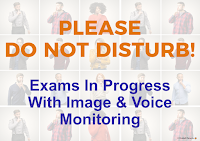
  • Put a Do Not Disturb notice on the door. If someone comes in by accident, send them out immediately - type a short comment in the chat widget, and report it in detail after the exam. Our Do Not Disturb notices also include full schedules for the exams, including the breaks.
  • ItC II.3 - Cover any see-through wall or door in the room through which another person might be able to see your screen 
    • Paper, card or opaque plastic may be used on the inside (see the picture above)
  • ItC II.3, 4 - To ensure correct facial registration, any window, mirror or other shiny or glossy surface or parts of these which are located behind you (i.e. facing the screen) must be covered. There must not be any light source pointed at the camera from behind you to keep the image clean. The background behind you in the image must not have any portraits with faces visible to the camera. Bookshelves behind your head during invigilation is not a problem. They don't need to be covered.
  • ItC II.5 - Listening to the radio or playing any other sound or music is not allowed. 
  • ItC IV.11 - Apart from the computer system (screen, keyboard, mouse, etc.), router and printer needed to take the examination, no other electronic devices (e.g. calculators, digital watches, smartphones and smartwatches) are permitted unless explicitly allowed by the Examination Secretariat in advance.
    • ItC IV.9 - no prohibited equipment may be "within reach". In other words, not within reach when you are sitting in front of the camera, keeping your face and ears within camera view.
    • Prohibited equipment may remain in the room if it is turned off and completely out of reach.
  • ItC II.7 and IV. 4 - You may use any printed materials, e.g. books, and any documents you consider useful for answering the examination papers. Prepare your desk before the exam.
    • Don't put posters on the wall that you wish to refer to. Looking at them could be considered a "suspicious look" - ItC VI.3.
    • Everything needs to be within reach without moving out of range of the camera.
  • ItC II.6 - Food, drink and medications are allowed. Standard, non-electric/non-electronic desk accessories are allowed (notepaper, pens, pencils, etc.).
  • Calendars are no longer provided with the exam. It is assumed that you either access the overviews of closed days published (once or twice per year) in the OJEPO during the exam, or print them yourself before the exam.
  • Answers to an earlier exam part written in a later exam part will not be marked.
  • Copy/pasting sections from legal references give no marks. It is considered equivalent to just including a reference. You are awarded marks for applying the law.
2. Hardware / Software (Feb 22)
  • It is strongly advised NOT to do exam from office using a company computer on a company network
  • ItC III.1 - read latest technical recommendations on official WISEflow page (epo-wiseflow.ladesk.com/772936- Lockdown-computer-recommendations). iPads may not be used. 
  • ItC IV.2, 3 - ensure WISEflow and LockDown (FLOWlock) browser are up to date. 
  • New requirement: you must verify the software at least once in the morning BEFORE each exam. 
    • To verify: after logging-in to WISEflow, click on the drop down menu next to your name and select "Edit profile" and "Test Browser". This will start the FLOWlock / LockDown Browser, and check that it is up to date. 
  • ItC II.4(a), IV.7 and IV.10 - The microphone must capture the sound around you and must be connected and active throughout the examination. Audio verification is required before you can access the flow. 
  • ItC II.4(b) - The camera should be positioned centred above or below the frame of the active monitor, but not more than 5 cm away from it. The camera is to be oriented to show a frontal portrait image of you when you are looking at the screen. It must not be covered at any time. 
  • ITC II.4(c) - Speaker settings must be adjusted so that sounds from the internet browser are audible and left on for the whole exam. Internal laptop speakers are fine if they are loud enough.
    • Invigilators can "beep" to get your attention through the chat widget, even if you are not on the first (editor) tab. 
  • ItC IV.5 - print as soon as parts are available. Refresh the page before launching FLOWlock Browser.
    • After opening the flow, refresh the internet browser page to see when the printable files become available. Use the REFRESH icon or F5.
  • ItC IV.11 - You are not allowed to use earphones, headsets or other, non-electronic noise-cancelling devices, such as earplugs. 
  • ItC II.5, 6 - Candidates are not allowed to use shortcuts (ALT+TAB, CTRL+P or similar), key combinations and touchpad gestures, except Ctrl+C, CTRL+V, CTRL+Shift+V, CTRL+F (and the corresponding Mac shortcuts)
    • these are the only shortcuts guaranteed not to crash the LockDown (FLOWlock) browser. This is a very safe list. See separate post for shortcuts that I have tested, but be aware that the sensitivity of each computer can be different. You need to determine yourself the degree of risk that you are willing to take. Mechanically blocking ALT and WINKEY should be considered to prevent accidents.
3. Create Your Own Evidence
  • Disclaimer: these are my general impressions, and will not cover all individual cases. I am not a lawyer, and this is not legal advice. If you are worried, then talk to your mentor or contact helpdesk@eqe.org
  • The intention of the rules is to provide a framework to sanction anyone who seriously breaches the rules or tries to cheat. If you do your best to comply with the spirit and letter of all the regulations and instructions, there should be no problems. AI proctoring is used together with people, so unexpected issues can be dealt with using common sense.
  • Last year, they were more flexible with rules, but they have more experience and they will be stricter. No unscheduled breaks during Pre-Exam, D1-1, and D1-2. In other parts, no breaks until 45 mins. Max. 3 mins for unscheduled breaks.
  • You can be asked by invigilators at any time to make a room scan with your camera. It will not be asked as a standard step for all candidates.
  • But different to in-person exams, potentially suspicious behaviour will be flagged by AI software. All the audio / visual / computer / network / keyboard / mouse inputs from each candidate are analysed after the exam (ItC VI.2, 3) and compared to other candidates (in 2021, approx. 1000 candidates for PE and approx. 2400 for some Main Exams). Decisions are not taken solely on these flags - the flags and the data collected will always be reviewed by the responsible EPO/epi members and they will contact you first. They also have your answers, how you answered, the speed and order of answering, and chat interactions for analysis and comparison.
  • And different to in-person exams, if you accidentally breach an instruction, you may not be warned. The invigilators can see real-time some of the data, but they will mainly be using video and audio (ItC V.2), and probably occupied with major issues and individual emergencies. So, if you are not contacted by an invigilator, that does not mean that no issues were detected by the system.
  • Read the EQE Data Protection Statement (version "_LS" - 08 Dec 21) on the official EQE online page, so you know who is retaining what data, and your right to access, rectify, erase and receive your personal data, as well as restrict its processing or object to the same. 
    • Reference is made to the EPO Guidelines for Protection of Personal Data. I could find them last year, but they seem to have been replaced by an amended EPO web page: Data protection & privacy. I cannot find the Article 13 & 14 being referred to in the EQE Data Protection Statement.
  • In general, personal data is deleted max. 30 months (2.5 years) after exam, or after appeal. Facial images, audio and biometric data deleted after 6 months, but if suspected misconduct or appeal, EPO will make a copy and retain for max. 30 months (2.5 years).
    • Consider creating a reminder by filing a PCT application on the day of each exam 😂.
  • You can expect that the rules will be interpreted in good faith, but the evidence being used is based on the data collection and AI. You are likely to be the only witness that you have complied with all the rules, but you do not control the data that is collected. 
  • If you are contacted days, weeks or even months after the exam, you will have forgotten a lot of details. So, put yourself in the best position to defend against being unfairly flagged. But don't go crazy - these are just all tips I could find. At least do something - any evidence is better than none. And hope you don't need it.
  • Report any issues or conflicts with regulations BEFORE the exam. Make PDF copies of the emails.
  • Prepare alternative and back-up solutions, and test your system as much as possible. 
  • Keep your mentor updated on any problems, and make sure they know the exact circumstances you are taking the exam. Preferably, they should also see your environment either in person or by video chat. If the mentor agrees, record the video chat with a time and GPS stamp. Or with photos with time and GPS stamp.
  • Before each exam, before you put your phone away, make a video with time and GPS stamp of the room, desk and computer. Include your point-of-view as you will take the exam, 360 degrees around, up and down. Under the desk, on top of the desk. Behind the monitor. Explain to yourself what everything is, and how they comply with the requirements. Mention anything you removed to comply with the requirements. Also include the ID you will be using. If there are glass walls and windows, show that they are covered. Show where the doors are, and what is on the other side. Still pictures are also possible, but a video is stronger evidence. If possible, include a witness or get someone else to film you. It should only take 5 minutes.
  • Put your phone out of the room (you don't want it to accidentally ring). Preferably, give your phone to someone else to keep during the whole exam. Don't record video and/or audio during the exam as this itself is a breach of the rules.
  • During the exam, if something happens that could be flagged, report it in the invigilator chat and make a note on paper so you don't forget. If you interact with an invigilator, write down the name of the invigilator. Do not close the chat before you have received an answer. You can minimise the window with "-". The chat is present in the editor tab, but it remains active when you are on another tab.
  • If appropriate for the issue, ask politely for more time in the chat. This is technically possible (they did give extra time for everyone for D1-1), but I don't know what the EQE policy is. I have not heard of any EQE2021 requests being granted in individual cases, but it does give them a chance to compensate in some way. Whatever the outcome of the extra time request, focus on the rest of the exam, and finish as much as possible to give them something to mark. 
  • Request a transcript of your chat by clicking on the option BEFORE the chat closes, and entering your email address. It gives you a full timestamped history. 
  • AFTER the exam, report any issues that happened during the exam as soon as possible. They take everything into account, but issues will not always result in extra marks.
  • If have made notes on paper or annotated printed pages, store them safely and scan them in. Store the unedited videos, photos and files somewhere safe. DON'T send the helpdesk your videos, photos and files.
  • Create official evidence using a third party. You should know how to do this for clients when they need to register something confidentially for copyright, trade secret, right of continued use or NDA purposes:  
    • i-DEPOT - upload up to 100MB of one or more files (any format), create and register a certified pdf, BMM retains it for 5 years, you can download a copy of the certified copy. (EUR 40). The certificate is officially recognised as an electronic signature by judges in all 27 EU countries. 
    • WIPO PROOF - store the files yourself unaltered, no file size limit, create and register a digital fingerprint, store and verify the fingerprint yourself (free)
    • truetimestamp.org -  create a SHA-2 hash fingerprint yourself . They have their own register of certificates (free).
  • Consider requesting a copy of the data they collected as described above (although it can take 3 months or more to get it)
  • If you are accused of suspicious behaviour, don't just send all your videos and files and hope for the best. Talk to a colleague or mentor. You will need to respond seriously, offering to supply selected parts of the evidence. Handle it like receiving a "cease and desist" letter.
Click on READ MORE>> for more analysis

Friday, February 4, 2022

e-EQE 2022: Avoiding FLOWlock Browser crashes, and how to get out

William Salinger's proposed use of a shim to block keys
Updated 15 Mar 22 to add blurry assignment preview
Updated 14 Mar 22 to add frozen chat window problem.

Updated 10 Mar 22 to clarify that you must print before starting FLOWlock Browser and added about backup computer.
Updated 9 Mar 22 to specify Refresh icon appearance (clockwise arrow). See comments in blue for important points from EPO info session on 8 Feb 22. Updated 7 Feb 22 with comment about asking for extra time and updated FAQs.
Updated 4 Feb 22 after comments and new Instructions to Candidates (see separate post).
This is an updated post, taking into account the improvements to FLOWlock browser (old name: LockDown Browser) and the experiences during the Mocks. I tried many different ways of crashing the browser to check whether the comments are still valid. The LockDown / FLOWlock Browser version used was 2.0.7.07 - 29 Sep 2021. I have only tested this on my Windows 10 - let me know if anything is missing, particularly for Mac's. 

Before exam:
Hardware / Software
  • Equipment that has worked once well during mocks will almost certainly should work during actual exam. Backup laptop or computer should not be needed
  • Consider a backup system: no problems during mocks is no guarantee that everything will run smoothly. If you are nervous, prepare a backup system (you can also use this to print before the exam - see below). This second computer must be turned off and completely out of reach in the room during the exam. Borrow a computer to which you can have full administrator privileges. The recommended technical specs are very low. Or ask your IT department if they have an old one that they can reset and give you administrator privileges.  
  • FLOWlock browser does not work like normal software - it is continuously trying to crash. Anything it considers suspicious will either be stopped, or will cause the browser to exit. System notifications or pop-up windows can also cause freezing. If in front of browser, you may not be able to click on them. If behind (invisible), you cannot navigate to them using ALT-TAB.  If behind, you also do not know what the cause is. 
  • It is strongly advised NOT to do exam from office using a company computer on a company network
  • Most of the problems with crashing and missing functionality is due to using a company computer or laptop where you don't have full admin rights and you can't disable scheduled tasks or other company tools. For example, critical urls can be blocked, IP addresses can be changed during the exam, virus scans and windows updates can start during the exam, screensavers/hibernation can be triggered by periods of inactivity (eg reading) during the exam. In addition, further restrictions may be imposed by the company network when at your workplace.
    • Better is to buy a refurbished / 2nd-hand used desktop PC for EUR 60-70, and to use that with administrator privileges. The recommended technical specs are very low. Or borrow one from someone else. Or ask your IT department if they have an old one that they can reset windows and give you administrator privileges.  
  • You will have the least chance of technical issues if you use a dedicated desktop with one screen (at least 27 inch), one camera, one microphone, one keyboard, one mouse, one loudspeaker device, one printer, direct wired (USB/HDMI) connections to all peripherals, administrator access, cabled (LAN) access. The chances of problems are further reduced by connecting to a non-company network. 
  • If using a laptop with USB external camera, set it up so that the laptop screen can be turned off and closed (only 1 screen/monitor may be used).
  • Only connect the hardware you need, and exit all software/apps except your normal internet browser. Also those running in the background, like backup software and synchronization programs (onedrive, dropbox etc). For Windows, I recommend creating a new account with adminstrator privileges to be sure that you are only running what you need.
  • Avoid using port replicators and docking stations. FLOWlock Browser disables "suspicious" processes on startup. Some people have had problems starting, and/or disconnection problems. This might be due to using a modern hub with more than one video output. Solution: use a simple USB-hub with only what you need.
  • To test your camera in WISEflow, click on the drop down menu next to your name and select "Edit profile" and Start FLOWlock to start the FLOWlock Browser. In the Assignment Options, click on "Appendix material" and "Manage appendices" to open the "Appendix manager" tab. In the "Appendix manager" tab, click on "New appendix", and then "Take an image". This looks like the "Entry image" screen used before each exam / flow. Unfortunately, there is no microphone test.
  • Avoid VPN. Can lead to slow connections. FLOWlock Browser also cannot handle changes in your IP address.
  • You can set up your phone as a mobile hotspot to use in emergencies, but your phone cannot be within reach during the exam. Your computer has to be set up to automatically switch, or you need to use CTRL-ALT-DELETE to switch manually (see below).
Disabling functions before the exam
Click on READ MORE >> for more details

Wednesday, February 2, 2022

Mock Exam: 3 Feb 2022 0930-1700 => last chance to test your setup

Updated 3 Feb 22 during Mock. Thankfully, the technical and functional issues with WISEflow and LockDown Browser are much less than last year. But candidates can still have individual issues due to hardware / software incompatibilities or disabled permissions. 

WISEflow now has a list of computer recommendations, and provides user guides and troubleshooting. Experience form last year is that you will have the least chance of technical issues if you use a dedicated desktop with one screen (at least 27 inch), one camera, one microphone, one keyboard, one mouse, one loudspeaker device, one printer, direct wired (USB/HDMI) connections to all peripherals, administrator access, cabled (LAN) access. The most chance of issues were with a corporate laptop without administrator access, laptop with an internal and an external camera, intelligent firewalls, or active virus scanners.

Use this LAST CHANCE to test your setup to make sure that you will not have any technical issues during the exam, even if you have already participated in an earlier Mock. At least join at the start of the session to run through the ID checks, and participate for an hour or so to check that the webcam and monitoring continue to work. The currently available mock flows will remain open until 6 March 2022, but you will not be able to test on your own with full invigilation.

The Pre-Exam mock will use Pre-exam (2021): Part 3 only. The Main Exam flow will be a single flow with all 2021 exams (A, B, C, D) - you may use any of the papers. 
  • The participant password is: abc
Things to do and to check:

  • Turn off screensavers, sleep/hibernate functions, scheduled tasks like virus checking and backup, and delay windows updates.
  • Printing. As in the real examination the printable parts will be made available approximately 10 mins before the start of the flow (you might have to refresh your browser page).
  • Taking entry images. Hold your valid ID card or passport into the camera, next to your face. 
  • Video and audio surveillance. Try the integrated chat widget (human invigilation will however be very limited). 
  • If you have a technical issue during the mocks, contact the invigilators using the chat widget. If this is not working, these are mocks, so you can also ask in the EQE Telegram Groups for advice. 
    • If you are kicked out and need to get back-in, enter WISEflow and start the flow (Lockdown Browser) and complete the ID check (if necessary). The chat widget appears bottom right before you are asked for participation or administrator passwords. So, you can access it from any computer with an internet browser where LockDown Browser is also installed.
  • The invigilator password was not shared in the e-mail, so you will have to request it from the invigilators if you have technical issues. The invigilator password is needed to enter the flow after the start, or to exit early. There are also other WISEflow functions that can be accessed when instructed by an invigilator, such as saving or printing.
  • Practice using the External references to see if they can be accessed. You should also try to search in the EPO Guidelines using Advanced Search, and navigate to the National Law tables. Browser shortcuts that work on my Win10: SHIFT+LEFT MOUSE (open in new tab), F5 (refresh - or use icon), ALT ← & ALT → (backward & forward - or use icon), SPACE or PAGE DOWN (scroll down), SHIFT+SPACE or PAGE UP (scroll up), HOME & END (top & bottom of page), jump to pdf bookmarks using toolbar icon, CTRL+SCROLL MOUSE (zoom - or use icon, or (i) options), CTRL+A, CTRL+C.
  • Practice opening tabs, copy/pasting into your answer, and searching in the exam. Try not using the computer for 10 minutes to see if your screensaver or sleep/hibernate freezes the system.
  • Test commands and actions that you may need, such as Winkey-SPACE for changing keyboard layout, F5 (or click on Refresh icon), CTRL-ALT-DELETE to allow a different network selection.
  • When you have practiced enough with the exam, you can see whether some of the actions that caused problems last year will still cause you to be kicked out. For example, using ALT-TAB and multiple-finger gestures on a touchpad. 
    • On my system: hitting ALT-TAB ONCE generates a warning that it is an unauthorised action, and if repeated will require the adminstrator password to continue.

Tuesday, December 21, 2021

EQE 2022 bug fixes, and lessons learned from EQE 2021

During the annual EQE Tutor's meeting on 19 & 20 Oct 2021 (online this year), EQE 2021 was discussed in detail, as well as the expectations of changes to be implemented for EQE 2022. The general approach is to slowly improve the issues: each change needs to be thoroughly tested to make sure improvements work reliably and do not make things worse. I have now tried the updated WISEflow platform and summarised the most important points and tips relevant for EQE 2022 based on the meetings and the experiences from candidates last year.

1. General advice:

  • Watch the EPO’s EQE pages for updates: EPO EQE online page, EQE Notices & Downloads, EQE FAQ's
  • Join the EQE Telegram groups to discuss issues with other candidates: Main group (283 members), Study group (108 members), ABC&PE-claims (167 members), D&PE-legal (137 members) and Marketplace (58 members). The groups are public, and open to any tutors or candidates. A few rules: treat others with respect, no discussion of cheating, no exchange of large sections of copyrighted materials (use of excerpts for study and discussion allowed). During scheduled exams, no discussion of the exam questions or answers. During mocks, no restrictions.
  • WISEflow and LockDown browser provide limited possibilities compared to daily online working, so practice as much as possible with them.
  • Do as many mocks as possible, even if you have not had any problems before. If short on time, at least do the initial part where the photos are taken and the flow is started. 
  • Practice using the External references, and decide beforehand what will be faster to look up on paper, and what will be faster online. 
  • Maximise your typing speed by taking an online typing course and using a comfortable keyboard / mouse. Become less dependent on answering on paper.
2. General IT advice = avoid issues
  • Although helpdesk will be available and there are possibilities for complaints and even appeal, any issues during an exam will cause at least 20 minutes to be lost, and there is a minimum amount for marking that you must hand-in to be awarded a pass. So, it is better to avoid issues as much as possible.
  • Lockdown browser is designed differently to other apps - it is not designed for stability, but to continuously monitor and to crash when something suspicious is detected. On startup, certain applications are closed. During operation, anticipated "forbidden" actions are blocked. But there will always be situations that are unexpected and unanticipated, particularly when running on the many different hardware/software configurations.
  • Software is being continuously updated, so past positive results during mocks do not guarantee that you will have no issues during the exams. 
  • Least chance of issues if you use a dedicated desktop with one screen (at least 27 inch), one camera, one microphone, one keyboard, one mouse, one loudspeaker device, one printer, direct wired (USB/HDMI) connections to all peripherals, administrator access, cabled (LAN) access.
  • Don't use: hardware and apps you do not need, VPN (changes to IP address crashes LockDown Browser), and docking stations/port replicators.
  • Turn off: screensavers, sleep/hibernate functions, scheduled tasks like virus checking and backup, and delay windows updates.
  • Most chance of issues: corporate laptop without administrator access, laptop with an internal and an external camera, intelligent firewalls, or active virus scanners.

 3. Advice about EQE 2022 Exams

  • Expect the 2022 exams to look very similar to the 2021 exams. Making exams takes 2-3 years in total, so the EQE 2022 exams cannot be fully adapted to the online format. It is not easy too split an existing exam into parts. EQE 2021 exams also had this problem - splitting was done by the relevant committee under responsibility of the Examination Board.
  • The version of WISEflow and LockDown Browser available at Christmas 2021 will be the final one.
  • More than one answer is frequently accepted (decided after the exam). But you can still fail if you are an acceptable answer track, and don't hand in enough to be marked. Make sure you hand-in as much as possible. 
  • B exam will be still be difficult because you cannot easily compare - no side-by-side viewing of tabs.
  • C exam will be difficult because of the split into two parts.

4. WISEflow and LockDown improvements for EQE 2022

  • Current version: LockDown Browser 2.07.07 - 18 Dec 21
  • Can now annotate exams when opened in a tab. Comments can be added, text can be highlighted, shapes can be added. These annotations are visible in all tabs where the exam is opened.
  • Opening too many tabs used to longer crash the LockDown Browser. The maximum number of tabs depends on the display size. Now, a warning is generated that tabs must first be closed before new tabs can be opened.
  • Can now apply strikethrough to text in the answer to be handed in.
  • Copy paste seems to me to be improved. However, this is a problem where they do not understand what the cause of the problem is, so it is not certain it will work well on all exams.
  • The invigilation has been integrated into a green hover button/window which remains on top in the answer tab. 
  • Language switching of assignment has been changed to avoid the D1.1 problem in 2021.
  • Side-by-side viewing of tabs is still not possible. Only the exam preview window can be viewed next to the answer tab, which is very limited in functionality.
  • Pre-exam: the three languages have been separated in the questions, but not in the answers.
  • ALT-TAB caused problems last year with crashes after being entered twice. It was stated during the 2022 exams that that it will just have no function. I have not seen any any problems during the mocks. I will try again in the full-function mocks in January.
Click READ MORE for other comments from Tutor's Meeting

Saturday, December 18, 2021

EPO as a PCT Authority (31 Oct 21) now available to order

EPO as a PCT Authority collects and organises the implementation details when the EPO operates under PCT It covers PCT filing (RO), search (ISA, SISA), and examination (IPEA) before the EPO. It also covers PCT-Direct, Supplementary PCT Search, regional entry into the European phase (DO/EO), and formalities after EP entry.

It is useful for daily practice by those dealing with the EPO. It also includes references considered essential for EQE exam candidates. 

It includes Indexed Versions of PCT-relevant Guidelines:
  • Euro-PCT Guide (EPG) - 1 Jan 21
  • EPO-PCT Guidelines (GL/PCT-EPO) - 1 Mar 21
  • EPO Guidelines (GL/EPO) – PCT part only (Ch. E-IX) - 1 Mar 21
Our Indexed Versions improves on the official version by grouping the index entries at the front and abbreviating entries to allow quick scanning, using page numbers to speed up getting to the correct page, indicating sections with significant changes in the last 3 years, including the complete official sources, retaining the original paragraph structure and the underlining of the legal citations, and modifying the contents to fully use the page size, giving better overviews of paragraphs.

It also includes:
  • Patent Prosecution Highway (PPH) and Validation procedures
  • OJEPO Decisions, Fees & Reductions for PCT
  • PCT Annexes for EPO as RO / (S)ISA / IPEA / DO-EO
  • PCT Applicant Forms & EP Entry Form 1200
  • Examples of PCT-related EPO communications

This version reflects the legal status on 31 Oct 21, so it is the official version for EQE 2022 Main Exam & Pre-Exam. See this post for comments on which legal texts to use. Note that answers at the EQE based on EPG and EPO-PCT Guidelines should be supported by EPC Articles, Rules, GL/EPO Guidelines (IPREE R.22) citations.

New this year is the A4-format (210 x 297mm) created by Ignacio Lobato, which reduces the page count. We now offer two versions, both with black and white contents:
1) Portable Edition - 17mm thick, using thinner 50gr "bible paper" to reduce the thickness and the weight to 750gr.
2) Study Edition - using thicker 80gr paper, which is more suitable for intensive tabbing, annotating and highlighting. It is 26mm thick and weighs 1250 gr.

We have also extended the details on Patent Prosecution Highway (PPH), added translation details to the EPC state overview, and extended the details on validation (including procedural flowcharts). Some of these EPO-specific details have been moved from the PCT Global Reference book.

The National Law & Validation book will no longer be produced. Access to www.epo.org during the exam will be available through External References, and online is the quickest way to find the required up-to-date National Law details. I have also moved the Validation details to EPO as a PCT Authority.

For more details, including the order links, and sample pages, see: fireballpatents.com/study-materials

Don't print WIPO Applicant's Guide for EQE 2022 - 2150 pages!

Every year, WIPO produces a printable version of the complete PCT Applicants Guide, including annexes for 154 States, specifically for the Pre- and Main Exams. Their 31 Oct 2021 version can be found here. It is 2150 pages and much of it will never be required at the exam. 

Providing a digital version has a low priority for EQE 2022, with resources being concentrated on improving the WISEflow exam interface. As noted in a recent post, online access will only be available to the www.epo.org domain during the exam. NO DIGITAL COPIES of other references will be available, and NO ONLINE ACCESS to other websites will be available. You also CANNOT OPEN any documents on your computer during the exam, so you will still need these PCT details on paper.

For many years, I have been making a cut-down PCT Global Reference to lighten the load and to save a few trees. Based on the syllabus, the Regulations, past papers and comments from Examination Committees, I have limited it to "only" 900 pages. There are also a lot of useful overviews from the WIPO/EPO website that WIPO did not include, so I have added about 300 extra pages, for a net saving of 850 pages. 

The latest edition is now available in two parts, and the links are here with my other study materialsThe downloadable version is expected in Jan 2022. There will be two versions of the PCT Global Reference (31 Oct 2021):
  • Two 16x23cm books (Part 1 & 2) for ordering. Both parts must be added separately to the basket. They comprise 1300 pages. After printing on thin bible paper, they weigh 1200g together, and are usually delivered in 10-14 days.
  • Two A4 files (Part 1 & 2) for download. They comprise 1300 pages and are provided free of charge for own printing. Please distribute to anyone who wants to use them for any non-commercial and unmodified use.
New this year is that I have taken out some of the EPO-specific materials to make room for more coverage of the most frequently used RO's and DO/EO's, and more Practical Advices. These EPO-specific materials have been added to the separate EPO as a PCT Authority book which has been updated to the 31 Oct 21 status. 

The National Law & Validation book will no longer be produced. Access to www.epo.org during the exam will be available through External References, and online is the quickest way to find the required up-to-date National Law details. I have also moved Validation details to the separate EPO as a PCT Authority book which has been updated to the 31 Oct 21 status.

Hopefully, a digital version will be available for EQE 2023, or the syllabus will be officially limited to reduce the number of States that could be asked about.

EQE 2022 - External References in WISEFlow and legal text versions

It was confirmed during the online EQE Tutor's Meeting in Oct 21 that access to www.epo.org will again be available during e-EQE 2022. Answers will again be accepted based upon texts accessible from www.epo.org which were valid on 31 Oct 2021, or valid on the day of the exam. 

It was also confirmed that NO DIGITAL COPIES of other references will be available, and NO ONLINE ACCESS to other websites will be available. You also CANNOT OPEN any documents on your computer during the exam. This may change in the future, but this currently has a low priority.

So, you will still need to print some references yourself before the exam. In particular, you will still need need PCT/WIPO references on paper, either by printing the official 2150 pages from the WIPO, or buying / printing our abbreviated and improved version: PCT Global Reference - Part (1) and (2).

No official calendars will be provided, so either print out the closure dates before the exam, or refer to the External References during the exam.

External References in WiseFlow

  • "External references" opens in a new tab to Home >Law & practice >Legal texts
  • Browser access to html and small pdf resources is limited to www.epo.org
  • Smaller pdf's, such as most OJEPO notices, can be opened. Large pdf resources, like Guidelines, cannot be opened. Each pdf opens in a new tab, and number of tabs is limited by screen size. No annotation or highlighting is possible - this is only available for exam pdf.
  • Browser shortcuts that work on my Win10: SHIFT+LEFT MOUSE (open in new tab), F5 (refresh - or use icon), ALT ← & ALT → (backward & forward - or use icon), SPACE or PAGE DOWN (scroll down), SHIFT+SPACE or PAGE UP (scroll up), HOME & END (top & bottom of page), jump to pdf bookmarks using toolbar icon, CTRL+SCROLL MOUSE (zoom - or use icon, or (i) options), CTRL+A, CTRL+C
  • Browser shortcuts that don't: CTRL+SHIFT+T, CTRL+T, CTRL+TAB (it just increases indents in your answer), RIGHT MOUSE (e.g. open in new tab), CTRL+E/F/K (no search function in html or pdf. Search is available for exam pdf only). CTRL+D, CTRL+P, CTRL+S.
  • Copy/paste is available into your answer, but that this DOES NOT get marks. Marks are available for APPLYING the law. Just copying in legal texts is no different to a  reference.
  • No browser bookmarks will be available or importable. There is no address bar, so urls are not visible and cannot be typed. Before the exam, get used to finding resources from the EPO home page, and practice using the html search. Note paths to critical references - these are pages that you often use in real life.
  • Test access during the mocks - some firewalls block access, so you may need to whitelist the whole www.epo.org domain. 

Key External References
Other External References (only in emergencies)
For details on official Guidelines versions, click READ MORE.