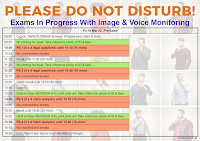
Showing posts with label pre-exam. Show all posts

Saturday, March 18, 2023

EQE: 17 Mar 2023 - Pre-Exam - no copy (sorry), but my comments

ItC => no ticket for you!
Friday was the e-EQE Pre-Exam (Part 1: 0930-1040 CET - 70 mins, part 2: 1100-1210 CET - 70 mins, part 3: 1330-1440 CET - 70 mins and part 4: 15000 - 1610 CET - 70 mins). Unfortunately, I was not able to get a copy of the questions, so I cannot share them. The EPO normally makes good copies available in the compendium in the week after the EQE.

  • I am keeping my fingers crossed for all 2023 candidates 🤞🤞🤞. 
  • If you had any issues with any exam that affected you efficiency, or it was not inline with your expectations, please file a complaint.  Formally, complaints must be formally filed no later than midnight on the day of the exam you are complaining about. Even if you have miss the formal deadline, submit all complaints that could affect your marking or performance as quickly as possible to helpdesk@eqe.org. 
  • You can also give a reason why you were not able to submit immediately after the exam, such as tiredness or needing to prepare for the next exam. Also realise that by filing a complaint, you keep your options open regarding an appeal. The first thing that is checked by the Disciplinary Board is whether you complained promptly after the exam. You are also creating a record while it is fresh in your mind. Even if it is something that you might feel is your fault, remember that the conditions under which you are taking the exam have been 100% determined by the EQE organisation and that you have no choice but to do it that way. Any issue that you may have is directly caused by these conditions.

  • Some tips for the e-mails from case law:
    • turn on the automatic read receipt confirmation
    • ask them to confirm receipt
    • ask them also to confirm that the email has been forwarded to the Examination Board
    • explain why you were not able to submit the complaint on the same day of the exam
    • keep bugging them until you get the confirmations.
  • My suggestions to candidates after the eEQE
    • Celebrate - you survived the third eEQE 🥇
    • Put your TAB and WINKEY caps back 😀
    • Manually uninstall Lockdown Browser: in Windows, it is found in the start menu under Respondus
    • Be suspicious of any emails mentioning WISEflow or Lockdown Browser or Respondus. if you get any emails about "updates" of the Lockdown Browser, do not click on them. Only update through WISEflow.
    • Preferably unplug all the extra cameras and microphones. Or at least cover the cameras when not in use.
    • Take a couple of days off and celebrate 😉
    • Don't read blog posts about model answers. They are usually made by EQE nerds who made the exams under relaxed conditions. They could still be wrong. Even if it is a perfect answer, no-one knows where all the marks will be awarded. 
    • The marking sheets are only finalised after the exam following discussions within the committees about what to accept and what not. For example, if there was an issue almost no-one dealt with, they usually compensate by awarding marks for something else that most people got. The exams usually have built-in fail-safes, so if you miss something, you will not lose marks everywhere. 
  • I heard some very disturbing news that candidates were not allowed late entry to the flows under any conditions. It was suggested that the Instructions To Candidates (ItC) have been amended on that point. In the version of Dec 2022 on the EPO website (why has these Instructions not been published in the OJEPO before the exam?):
    • I. General  
      • 2. Candidates must enter the online examination environment as stipulated in point IV below at the official start time
      • 4. Candidates who enter the online examination environment after the official start time of a particular examination paper or paper part may not make up the lost time at the end. 
      • 5. Candidates will not be allowed to enter the online examination environment more than 15 minutes after the official start of each examination part (flow).
    • IV. Preparation and start of the examination
      • 8. After completing the above steps, candidates must immediately launch the lockdown browser. The lockdown browser launch procedure should be run at the start of the examination but must be completed no later than 15 minutes after the examination start time. Otherwise, candidates will not be able to enter the flow and sit the respective paper or part thereof.
  • Note that in the last version that was actually published in the OJEPO before EQE 2023 (OJ 2022, A20), these sections read:
    • I. General
      • 4. Candidates who fail to log on to the FLOWlock browser by the official start time of a particular examination paper or part of a paper may not make up the lost time at the end unless, in exceptional cases, the invigilators decide otherwise.
    • IV. Preparation and start of the examination
      • 8. After completing the above steps, candidates must immediately launch the FLOWlock browser. The FLOWlock browser launch procedure must be completed no later than 15 minutes after the examination start time. Otherwise, candidates will not be able to sit the EQE.
  • It is not clear to me from either version that this is a hard deadline which cannot be overruled in certain circumstances. Candidates can only take this exam 1x per year - if they are casually denied entry, their careers can be jeopardised and they can be severely demoralized.
  • In at least one case, the candidate contacted the invigilators who stated that late entry was not allowed because they had printed out the materials and could have passed them on to someone else. So, the candidate was prima facie accused of cheating without any evidence or chance to defend themselves, and not allowed into the flow at all. 
    • It reminds me of the infamous Munich ticket machines pictured above that randomly don't accept credit cards, bank notes over 20 Euros, coins etc, and guide you through endless menus only to reset if you take too long to choose. No ticket for you!
  • This absolute exclusion cannot be true - the normal procedure should be that the candidate is allowed to do the the exam and the "suspicious" situation is reported to the Examination Board. 
  • It is clear in ItC IV. Misconduct (OJ 2022, A20) only the Examination Board is allowed to take a decision regarding cheating, not the Secretariat:
    • 3. Suspicious events during the examination pointing to potential cheating, e.g. suspicious looks in a particular direction, that are detected during the retrospective review of the video and audio recordings can be punished by the Examination Board under Rules 19 and 20 IPREE. The Examination Board may do so even after the examinations have been marked and the results published. 
    • 4. Other breaches of the instructions may also lead to consequences for candidates and may attract further consequences under Rules 19 and 20 IPREE.

Thursday, March 31, 2022

Still struggling with PCT ?

TLDR: the most advanced and comprehensive guide to PCT law & procedure
Welcome to PCT.App !

  • By IP.appify www.pctapp.net/en/pct-app
  • The only self-editable guide to PCT (Patent Cooperation Treaty).
  • Readable on your mobile phone & tablet. It is extensively commented, with many summaries of key issues. The screenshot above is simulated"See Inside" for examples of actual screenshots.
  • Search full-text, and navigate with hyperlinks & cross-references to internal & external resources.
  • Organisation is chronological, mirroring the lives of PCT applications. 130 subjects include overviews and paragraphs from the most relevant provisions. All PCT Articles & Rules are included at least once.
  • Self-editable online using a browser. Freely adapt the references online with your own comments & highlighting, and hide any unwanted parts. For editing & modifying content, we recommend using a larger screen with a mouse & keyboard.
  • No need to transfer notes - legal updates are automatic without disturbing your individual content.
  • Make printable colour pdf's at any time, or use our Print-On-Demand service for color hardcopies.
  • Crucial for daily practice, essential for the EQE (Qualifying Exam for European Patent Attorneys).
  • Also available as a fully-commented black-and-white paper book. Editing and colour hardcopies are only available to online subscribers.

To Do in 2022:

  • Subscribe to PCT.App, the most advanced and comprehensive guide to PCT law & procedure.
  • For lawyerspatent attorneys and formalities officers.
  • Available in English and German.
  • By IP.appify www.pctapp.net/en/pct-app
  • "See Inside" for actual PC and mobile phone screenshots, explanation of the structuresample downloads, the Index and the Detailed Contents lists

Reviews & Recommendations:

Nominee - IPKat Book of 2021 / Yellow Sheet (Nov 21) / Salted Patent (Apr 21)

  • EPC.app and PCT.app helped me a lot in EQE Paper D - I did not even need to annotate it
  • Pete's PCT.APP book saved me on EQE Paper D1
  • I found it to be very good for EQE D exam. The plain language and keyword index made it work for me
  • Being able to edit the contents to how I see fit was a surprisingly easy experience
  • Organising PCT.App by subject in the order that an application would go through PCT gives an intuition that I haven’t found in other materials
  • How convenient to have Till & Pete update your go-to EPC & PCT so they are always up to date
  • Can´t recommend enough for EQE candidates as well as anyone in the profession
  • I always had the material, with my own annotations, available online and as a printed book

© IP.appify GmbH

Sunday, March 20, 2022

e-EQE: 18 Mar 2022 - Pre-Exam - copy to try yourself

  • Friday was the e-EQE Pre-Exam (Part 1: 1000-1110 CET - 70 mins, Part 2: 1130-1240 CET - 70 mins, Part 3: 1400-1510 CET - 70 mins and Part 4: 1530 - 1640 CET - 70 mins). 
  • If you want to try yourself, see here for the files: PE-1-2-3-4-questions-EN (2022), PE-3-printable-EN (2022), PE-3-printable-FR (2022), PE-4-printable-EN (2022), PE-4-printable-FR (2022). Sorry, no DE printable files.
  • The questions (only EN, sorry) and statements (in DE/EN/FR) were only available digitally, and have been extracted from candidate's answers. The questions from all parts have been combined in one file.
  • Unfortunately, the pages in the candidate copy are saved as low-resolution screenshots, so it was not possible to accurately OCR the text. The font is a little small, but certainly readable on-screen. 
  • The order of statements is randomised between candidates, so statement numbers have not been used.

Friday, March 18, 2022

e-EQE: 18 Mar 2022 - Pre-Exam - (copy in separate post) last exam

Updated 20 Mar 22: copy to try yourself is in separate post
Updated 18 Mar 22: some technical and language problems

Today was the e-EQE Pre-Exam (Part 1: 1000-1110 CET - 70 mins, part 2: 1130-1240 CET - 70 mins, part 3: 1400-1510 CET - 70 mins and part 4: 1530 - 1640 CET - 70 mins). Unfortunately, I was not able to get a copy of the questions, so I cannot share them. The copy to try yourself is in a separate post. The EPO normally makes good copies available in the compendium in the week after the EQE.

  • I am keeping my fingers crossed for all 2022 candidates 🤞🤞🤞. 
  • The choice of topics for the legal questions seemed different from previous years. After all the issues with calendars, they have decided not to require any time limit calculations. Coincidence?
  • I have not made it yet, but check the Telegram groups for some discussions and comments. Today there were not a lot of discussions - most seem to be happy to have survived the second eEQE, and to start the weekend early. Some short discussions about complexity. 
  • No widespread Some technical issues reported during Pre-Exam 👍👍👍 - see below
  • If you had any issues with the exam, report them as soon as possible to helpdesk@eqe.org. Formally, complaints must be formally filed no later than midnight on the day of the exam you are complaining about. I have helped update Preston Richard's template for EQE complaints to make the process a little easier, especially after a tiring day. Even if you have miss the formal deadline, submit all complaints that could affect your marking or performance as quickly as possible. You can also give a reason why you were not able to submit immediately after the exam, such as tiredness or needing to prepare for the next exam.

1. Thanks to the EQE organisation, and good luck with the marking
  • Thanks to all the invigilators, helpdesk staff, EQE secretariat members, and epi/EPO members who have been working tirelessly for the last few months to make it happen. Even under pretty stressful conditions (on both sides), many candidates had positive experiences of the invigilation system. 👍👍👍. 
    • the only issues seem to be with the capacity and thus the wait time
  • And good luck to those involved in the marking - at least you will not have to struggle with poor handwriting any more 😉, although there are a lot of spelling mistakes and copy/paste errors to puzzle over.

2. My suggestions to candidates after the eEQE
  • You survived the second eEQE 🥇
  • Put your TAB and WINKEY caps back 😀
  • Manually uninstall Lockdown Browser: in Win10, it is found in the start menu under Respondus
    • be suspicious of any emails mentioning WISEflow or Lockdown Browser
    • if you get any emails about "updates" of the Lockdown Browser, do not click on them. Only update through WISEflow.
  • Preferably unplug all the extra cameras and microphones. Or at least cover the cameras when not in use.
  • Take a couple of days off and celebrate 😉
  • Don't read blog posts about model answers. They are usually made by EQE nerds who made the exams under relaxed conditions. They could still be wrong. Even if it is a perfect answer, no-one knows where all the marks will be awarded. 
  • The marking sheets are only finalised after the exam following discussions within the committees about what to accept and what not. For example, if there was an issue almost no-one dealt with, they usually compensate by awarding marks for something else that most people got. The exams also have built-in fail-safes, so if you miss something, you will not lose marks everywhere. 

3. Telegram chat groups

  • Join the EQE Telegram groups to discuss issues with other candidates: Main group (324 members), Study group (133 members), ABC&PE-claims (206 members), D&PE-legal (166 members) and Marketplace (72 members). The groups are public, and open to any tutors or candidates. A few rules: treat others with respect, no discussion of cheating, no exchange of large sections of copyrighted materials (use of excerpts for study and discussion allowed). During scheduled exams, no discussion of the exam questions or answers. During mocks, no restrictions.
4. FLOWlock / Lockdown Browser
  • Many language errors in the navigation buttons
    • PE-1 and PE-2: button labels were in German, PE-3: button labels were in French, PE-4: button labels were in English. These languages could not be changed by changing the assignment language.
    • when the problem was reported, the invigilators provided translations 
    • the questions and statements were visible in DE, EN, and FR
  • Some problems handing-in Pre-exam answers
    • This was a major problem yesterday during C1 and C2. There it was related to the high number of candidates handing in relatively long exam answers. I am not sure of the numbers for Pre-Exam this year.
    • This is an area where WISEflow and the FLOWlock Browser work well - you need to first try refreshing (F5 "clockwise arrow" at the top left). If that does not work, contact the helpdesk who will guide you. 
    • There are many options available to the invigilator, including downloading your answer locally using an administrators menu and emailing it. FLOWlock Browser is continuously saving versions local and cloud versions of your answer. But always  check your answer to see if it seems complete.
    • Even if you managed to file your answer and everything seems fine, you should still file a complaint. it is unlikely that there will be problems, but just in case some of your answer got corrupted or appears missing. They can then double check if something looks strange during the marking.

Thursday, March 17, 2022

e-EQE: 18 Mar 2022 - Pre-Exam - good luck!

Final preparations
Updated 11 Mar 22: added entry photo requirements
Updated 10 Mar 22: clarify that you must print before starting FLOWlock Browser
  • This is a detailed exam schedule for Pre-Exam (PE) 2022, indicating scheduled and unscheduled break times. 
  • Don't forget your calendars
  • External Resources at www.epo.org are available online during the exam. For all other materials, such as PCT Applicants Guide, you will need to have them on paper.
  • Be prepared to contact the invigilators by chat widget, and be prepared to deal with FLOWlock Browser crashes. Only in emergencies and if the chat widget is not available, call the epo helpdesk: +49 89 2399 5155. Telephone lines are very limited - the chat widget is strongly recommended. Communication via email will not be dealt with.
  • Last year, candidates received an e-mail with a hyperlink just before the exam. This year, no email will be sent - the flows will made available well before each of your exams, so you will see them after logging into WISEflow.
  • Get everything ready early so you can relax. It is recommended to log-in 60 minutes before the start of the first flow. This will also give enough time to make sure that the room requirements are complied with, and to create your own evidence.
  • Print BEFORE starting the FLOWlock Browser: 10 minutes before the start of the exam, any printable documents will appear on the flow page. Click on the refresh icon (clockwise arrow) or press F5 to see them. 
    • It is also possible to print using a second computer logged into WISEflow, but this second computer must be turned off and out of reach during the exam.
During the exam
  • Have a valid official photo ID (identity card or passport) ready and keep it within easy reach during the whole exam. You MUST verify your identity at the start of EACH FLOW by holding your ID next to your face for the entry photo. See Instructions to Candidates ITC IV, 6.
  • During the exam, you must to stay in front of the camera - everything you want to use must be within arms reach. 
  • Don't lose track of time ⏰ during the scheduled lunch break - if you are more than 10 minutes late, you may need the invigilator password to start the flow
  • During scheduled exam times and scheduled breaks, don't go online discussing the exam or share confidential exam info, such as personal login details & invigilator passwords. Wait until the scheduled end of the last part of each exam - after that, you can freely discuss. But remember - no-one knows the expected answers and which alternatives will be accepted.
Make sure you answer ALL the questions
  • If you are not sure of an answer, or you know it will take a long time to figure it out or to look it up, leave the question(s) until the end. But make sure you give an answer to each question before the end of the part.

Good luck!

Monday, February 28, 2022

e-EQE 2022: Take Simple Calendars on Paper to Exam

I was not planning to post this so close to the exam, but I have been getting a lot of questions about Calendars. You only need to know the EPO closing days, but you need the weekends on paper. I have also made some calendars you can use - as pdf (in English) or as Excel (so you can edit yourself or change language). Also includes comments on calculating time limits and when closing day extensions are to be used.

Time limits at the e-EQE (Main Exam and Pre-Exam)

  • Calendars are no longer provided because the EPO closing days are available online during the exam. But there is no change compared to previous exams how questions are asked where time limits need to be calculated. You are only expected to know the EPO closing days based on the relevant OJEPO notices (usually once or twice per year). This was confirmed in the EQE info session of 8 Feb 2022. 
  • For EQE 2022, you need to know the weekends and closing days for EPO offices in 2020, 2021 and 2022. The relevant OJEPO's are: 2020 in OJ 2020, A56 (22 May 20) and OJ 2019, A97; 2021 in OJ 2021, A4; 2022 in OJ 2021, A85. Although these OJEPO's are available online, there is no digital calendar to figure out weekends, and you cannot use one on your computer (or phone) during the exam. So, you need them on paper.
  • Each national office and the IB have their own closing days - you are NOT EXPECTED to know these during the EQE, but you can assume that these offices are also closed in the weekend. If it is critical to answer a question, they will give you the details in the question. 
  • If they expect you to take into account a disruption, like COVID or a hurricane, they will give you all the facts that you need. They want to test whether you know the relevant law and know how to apply the law to those facts - they are not interesting in testing whether you can find such facts.
  • It is useful to have examples of such a disruptions as an overview of possible EPC and PCT remedies. For example, OJ 2020, A120 describes remedies when electronic communication is not available. For example, OJ 2020, A123 describes remedies when a disruption, such as COVID, occurs.

Avoid calculation mistakes
  • Every year, candidates lose many marks because of avoidable mistakes in time limit calculations. A wrong calculation can lead to missed marks or lead to time being wasted on irrelevant details. 
  • Under the stress of the exam, don't rely on your fingers or in your head - count the days/months on the Calendar. Always double check any critical calculations. Common mistakes include: 
    • converting the written form of months in questions to the wrong month number. Mistakes are often made with June, July and August, for example (months 6, 7 and 8).
    • assuming that every month has days 29, 30 and 31 (even February). If the "last day of the period" ends on a day that does not exist, it is shifted to the real last day of that month - R. 131(4) EPC and R. 80. 1 PCT.
    • using the calendar for the wrong year (for example, 2020 instead of 2022).
    • ending a period calculation in the wrong year. This is usually with the time limits longer than 12 months. Double check, or break the calculation down into smaller steps, for example: 
      • 0 (priority) + 12m = 12m for end of priority year
      • 12m + 6m = 18m for publication
      • 18m + 12m = 30m for most national entries
      • 30m + 1m = 31m for EP entry

Sunday, April 18, 2021

e-EQE – epi discussion paper - comments

Update 21 Jun 21: I have also made some of these points in epi Information 02/21
8 Jun 21: forum link added.
The epi recently published their discussion paper on proposed changes to the EQE from 2024. See below for some comments, following on from my earlier comments on the future of the EQE.  It is also possible to discuss using the epi-learning forum (open to all).

My conclusions: 
  • Some good ideas, like allowing an earlier start of learning, but I miss any proposals to improve the organisation. 
  • I miss a proposal for permanent education - the EQE tests whether a small number of representatives are fit to practice at that moment. 
  • I hear more and more candidates choosing to follow a law degree instead of the EQE because of the unpredictability of passing. Having everything modular will help prevent this getting larger.
    • But we also need a clear syllabus for each part, transparent marking and a proper way to address the concerns of the average non-native speakers.
  • Infringement has to be added - it is an essential part of being a patent attorney.
My comments:

1. Is the current EQE adequately testing the “fit to practice” criterion? - p.1
  • Some Exam Papers are ... jigsaw puzzles ... rather than testing real skills ...
    • It is not a problem if questions are designed to have one answer - the legal questions are set up like this. Having small puzzles that fit together, like the current Pre-Exam - claim analysis and D2 does mean that you can feel when you are on the right path.
    • However, the general advice to pass currently is to not think too much and give the answer in the Guidelines because alternatives are almost never accepted, even if properly argued. Perhaps that way that the questions are structured needs to be clarified - instead of asking, is it novel/inventive/extension etc, you can ask whether the EPO will object (the Guidelines answer) - candidates should know what will happen during proceedings.
    • The biggest current "puzzle" is the C exam - it is completely out of control (not just this year). There are too many different documents and the pieces you need are not always in the most likely places. Way too long, too many documents, with a ridiculous amount of detail require for argumentation. 
    • The B exam is now going the same way. 
  • All papers should start with 0 marks, and award marks for correct parts. A and B suffer the most because they are negatively marked - you start with 100 marks, but lose marks for each deviation from the expected answer. The problem is that by misreading or misunderstanding a couple of things, you end up running out of materials to use. There is a randomness to passing - if you are on the same wavelength, you pass. If not, you fail. But if you retake it a year later, then you can pass without preparing any differently.
  • Marking of the practical papers should always consider whether a mistake would be correctable in real-life 
      • Why should you be afraid for A of submitting a non-novel claim or non-inventive claim? As the argumentation supplied tends to be brief for A (as it reflects the brief argumentation typically included in a patent application), you should not lose so many marks if a dependent claim is what they wanted. There should be no marks lost for extending a feature beyond the scope of the client's letter, for example.
      • For B, where argumentation is required, the reasoning can be judged better for possibly having a non-novel or non-inventive claim. There should be no marks lost for not abandoning scope based on an instruction by the client if you think it is patentable (and argue this). 
      • Why is matching EVERY feature and correctly defining closest prior art in C such an issue? For an opposition, the main thing is to attack all the claims, get all the documents in, and argue the non-trivial aspects of the feature matching and inventive step. You would not write an opposition like that.
  • Methodology courses - p.1, p.2
    • I may be a little biased ;-), but I am not sure why it is a goal to get rid of these. Most of the methodology courses are based on reverse engineering and save candidates a lot of time that they can use for actually practicing papers. I don't think these will disappear, even with a more modular exam and shorter pieces. 
    • These are currently "needed" because the exams are much too long (so very difficult to do in the time available, especially for non-native speakers), there is no official info about what is to be tested, how the papers should be made, or how they should be marked. The Examiners' Reports are not easy to read and deliberately leave out a lot of details on alternatives that were accepted, or the exact marking. Even if candidates file an appeal, they will never see the details of their marking to see where they lost marks. 
    • If there are tricks that is being taught to pass with little preparation, obviously this should be prevented. But I don't consider pointing out where marks are awarded and how to score those marks as a trick - all marks count equally to the scoring, and candidates should always focus on their strengths and understand what is required. I don't see weak candidates passing just through methodology - more that there are a lot of well-prepared candidates who fail because they do not know how to show their working properly within the time available. Hardly anyone ever gets about 80 marks for certain exams.
    • I agree that it should not be necessary to follow such a course to pass. The committees and boards can influence this already => a clear syllabus that they stick to, openness about the marking and what is expected, using similar formats and styles each year, announcing new subjects to be tested or changes to the marking in advance, publishing several alternatives that were accepted, allowed appealing candidates to see exactly where they lost marks etc.
  • Practical training
    • This varies greatly, depending on where you work and the opportunities available - there should be more guidance on what you should be doing and some help with this. 
    • I agree that that it is better to prepare earlier and not make exam participation dependent on a fixed number of years - for example, a lack of drafting and amendment experience can be compensated by doing more old exams to learn the skills needed. You need the knowledge as early as possible.
  • Suggestion - allow qualified attorneys, lawyers, employees, formalities officers etc. to also sit the modules (without overwriting their scores) to allow them to stay up to date in a structured way. This could already be done for the Pre-Exam (no consequence - they just get marks separately for legal and claim analysis).
CLICK BELOW FOR MORE COMMENTS

Saturday, April 10, 2021

Lessons learned from e-EQE 2021 and looking to the future

Updated 18 Apr 2021: see also my post commenting on the epi discussion paper.
Updated 12 Apr 2021.
"It is only when the tide goes out that you see who's been swimming naked"
I already posted these comments on LinkedIn - this post gives a little more background. There was an enormous effort behind the EQE scenes, and a lot of people working many extra hours, but this could not prevent cracks appearing. 
On reflection, I think a few long-standing EQE issues may have played a role in creating the problems:
  • No effective communication with most candidates. Email is fine for sending standard messages, but there is little chance to request additional information. It is not always clear whether candidates actually receive them and understand the intention behind the emails.  A lot of candidates are surprised by changes in exam formats as not everyone prepares using a tutor, or with other students to discuss things.  
  • Secrecy and little transparency about every aspect of the exam and organization. Seen particularly by candidates who fail - it is very difficult to figure out where marks were missed, why the official answer was preferred, what alternatives were available etc. But this year, it was promised that the exams had been adapted to take into account the new format, but it was refused to provide any details as this was related to the content of the exams.
  • Just enough volunteers to make and mark the exams. No one expects perfection -  limited resources means that not everything can be addressed. But it is a professional exam, so it should be possible with sufficient preparation to have a reasonable expectation of passing. There is a minimum level that should always be achieved.
  • Few real limits for each paper in what can be asked. A real problem for many candidates is the habit of regularly introducing new things not announced before or tested before. It is unheard of in any other professional exam not to have an official detailed syllabus of what you need to know, both for the legal parts and the practical subjects. The REE is too vague to be useful, so candidates prepare based on unofficial study guides (like CEIPI or EQE Guide for Preparation) and doing old exams. There is still no clear distinction between legal subjects tested at Pre-Exam level and Main Exam level.
    And it is ridiculous that every year candidates need to have 2000 pages from the WIPO in case a question is asked about a PCT state (in many years, the WIPO and National Law are not needed at all).
  • Few real limits for each paper in length and style. Since 2017, an extra 30 mins was added to each Main Exam so that non-native speakers have more time. But there is no clear way in which this is enforced, and it is clear that the time has been eaten up by the exams. 
  • No effective way to assist those with En/Fr/Ge as a 2nd language. Non-native speakers have a clear disadvantage. The patent attorney terminology manuals are very useful, but reading/typing exams can still be slower. And giving everyone an extra 30 mins has now lost its effect.
Normally, these are compensated by a lot of flexibility in the marking, and that will be repeated this year. So, anyone well-prepared who generated a reasonable answer has a good chance (as in all other years). But moving forward, some suggestions of possible improvements:
  • Make e-EQE improvements highly visible, so that candidates know what to expect (platform + content) and can properly prepare. 
  • Using the new possibilities, better define the content to be tested and make sure it is relevant to daily work. 
  • Have a proper official syllabus for each exam - articles and rules, sections of Guidelines, case law, OJEPO's. 
  • Limit detailed PCT questions outside Europe to IP5 countries, and provide resources electronically.
  • Remove overlap in testing and preparation (candidates & committees). For example:
    • Pre-Exam: limit to only only legal questions, covering procedural and substantive law. Drop Claims Analysis (covered extensively in A, B, C). Use a mix of multiple choice and "D1"-style questions to test D1 level of knowledge. This is main test of legal knowledge.
    • Allow ME: A and ME: B to be taken anytime - either with Pre-Exam or Main Exam. These are practically oriented, relating to skills which are being developed early (drafting and amendment).
    • ME: A can be cut in half => reduce subject matter, focus mainly on independent claims,  provide less prior art.
    • ME: B is ridiculous with client giving you claims. Go back to old format, cut in half => reduced subject matter, only include a few claims, provide less prior art.
    • ME: D - limit to current D2 (D1 is now in Pre-Exam). But also include some basic trademarks/designs and basic trade secrets. Test legal concepts, and not substantive patent law (or greatly simplified substantive law).
      Expand basic foreign knowledge (JP, US) to include CN, KR (IP5). Also define clearly what you need to know. Possibly also test something about those foreign national patent systems. Knowledge of DE, FR and UK systems would also be useful.
    • ME: C has much repetition in attacks. Cut in half => fewer claims, provide a lot fewer documents. There should also be a proper infringement part in EQE - it makes most sense to add it here as technical understanding is important.
Perhaps also look even wider, putting the EQE in a broader perspective. A lot of effort is put into only passing candidates who are fit to practice, but there are many other people who interact with the EPO at different levels:
  • Permanent education required for qualified attorneys. For most, a lot of the knowledge is lost within a few months of taking their last exam. I know there were some attempts in the past to introduce this, and I know that no system is perfect, but something must be better than nothing. This would also address the issue of the varying knowledge levels of grandfathers \ grandmothers.
  • European formalities officer qualification. These are the people who have the most up-to-date procedural knowledge in the offices, but the levels of knowledge vary wildly. 
  • European patent agent qualification. Similar to US, where a basic knowledge of procedural and substantive law needed for those interacting with the patent office. This would be useful for people who do not wish to become patent attorneys (yet), or work in a company's patent department, or work in a lawyer's office.

Tuesday, March 2, 2021

e-EQE - Pre-Exam 2021: copy to try yourself, and some technical problems

Today was the e-EQE Pre-Exam. If you want to try yourself, see here for main copy with EN printable parts, and the printable parts in German and in French. Sorry - it is a bit of a mess, but the pages produced by LockDown Browser seem to be a little unpredictable. I also deleted the T/F answers, so you will not be influenced.
The EPO normally makes good copies available in the compendium in the week after the EQE. 

I have not made the paper yet, but check the Telegram groups for some discussions and comments

  • A number found it more difficult than exams of previous years
  • Having DE, EN, FR below each other is not so nice for reading, especially with claim sets and comparing with questions

1. Telegram chat groups

  • The main group has 230 members, for general issues and WISEflow + LockDown Browser + Zendesk issues. The (ABC+PE claims analysis) group has 102 members, the (D+PE legal) group has 97 members, and the summer study group for EQE 2022 preparation already has 57 members.
    • Mainly for students to discuss with others, but also open to any tutors. 
    • If you have just done an exam, only discuss the answers if you can really take it. For most people, it is better not to discuss - you can't change your answer, no-one knows what the marking will be for particular answers (Main Exam) and sometimes more than one Pre-Exam answer is accepted. 
    • Group rules: no discussions of ways to cheat, no exchanges of large sections of copyrighted materials (excerpts, annotated examples, WIPO/EPO docs etc. are allowed), no requesting or sharing of exam materials until after the scheduled end of the last part of that exam, no requesting or sharing of invigilator password.

2. WISEflow, before the exam, after the exam
  • Prior art documents were available 20 minutes before (as promised) 👍
  • Own answers were available about 20 minutes after the scheduled end of the last part (as promised) 👍

3. Technical problems (Several reports of webcam issues)

  • a) Screen partially black due to failure in starting LockDown Browser. Problem seen in Mock1, reported to helpdesk, moved to cable connection instead of WiFi which seemed to help.
    • Contacted the invigilators and managed to enter Browser again using invigilator password after 20 min or so
  • b) Laptop with external monitor and external webcam. All worked fine in the Mocks. Before Pre-Exam, entry photo was no problem. But during exam, contacted by Zendesk and told that his webcam only took black photos. Candidate deactivated laptop camera in device manager, but didn’t help and he got contacted again. Not sure how it was solved
    • it seems likely that LockDown Browser later defaults back to camera selected automatically default in screen to take entry photo
    • some suggested disabling internal webcam in software if you have this setup
    • one tried unplugging USB plug of webcam and this helped

  • c) Laptop with Win 10, external monitor and external webcam, laptop lid closed during exam, all screen savers, lock screens, energy saving modes etc turned off, privacy settings adjusted accordingly and webcam given full access to apps, including desktop apps. During system tests in Wiseflow, Mocks 2 & 3, no apparent problems, 
    • During Pre-Exam, entry photo successful. In Part 2, contacted via zendesk, and told that cam not working correctly. Could not solve issue, allowed to carry on. 30 mins before Part 3, in contact with technical expert => disabled integrated webcam of my laptop, did Part 3 without interruption. In part 4, contacted again as camera sending black photos, i.e. the same problem as before. It seems as if laptop and external webcam is a known problem. => opened lid, but no change. Allowed to complete Part 4.
    • All invigilators very friendly and tried to help.👍 Still it cost a lot of nerves and time.

4. Invigilation

  • Many positive reports that contact was made quickly 👍
  • However sometimes delay (15 mins) when there was a technical issue, or when getting the invigilator password 
  • For refreshing Zendesk chat every 30 minutes, one candidate indicated that a refresh option will be visible on the chat when it can be done

Monday, January 25, 2021

Russell IP EQE Webinars 2021 now available

This was a great initiative - Russell IP hosted almost 10 hours of free tutoring last week, primarily for candidates affected by the cancellation of  EQE 2020. From across Europe and further afield, almost 400 candidates attended the five webinars.

Recordings of the webinars, copies of the presentations, and several templates are now available on the Russell IP website (with kind permission from the tutors).

I add my thanks to everyone involved - it is not easy to find time to do this. But a little support makes a big difference to candidates in this challenging year!

Jointly initiated and coordinated by Iain Russell (Russell IP) & Guy Warner (Unilever). Tutors: Pre-Exam – Jonathan Hewett & Kathryn Rose (Venner Shipley LLP); A & B - Guy Warner (Unilever) & Iain Russell (Russell IP); C – Paul Beynon (Appleyard Lees IP LLP); D – Kirsty Simpson (Venner Shipley LLP) & Gemma Wooden (EIP).

Wednesday, April 22, 2020

EQE 2020 officially cancelled, focus on EQE 2021, e-EQE 2022

After much speculation, the EQE Supervisory Board has decided to officially cancel EQE 2020. It was not unexpected - "for the first time in xxxx years, yyyy has been cancelled" has become a frequent headline this year.
The decision is available here as well as a communication providing more details.

Some comments:
  • "composed of an equal number of representatives of the EPO and the epi" - stresses that it is a joint EPO/epi exam. That saves me having to comment on many blog comments :-)
  • "the nearly 3.000 people that participate and are involved in the organisation of the Exams" - based on last year's figures, approx. 900 Pre-Exam, 1700 Main Exam candidates, 400 organizers/invigilators.
  • "actively discussing solutions ... strike the right balance between the legitimate expectations of candidates for the 2020 exams and .... health and safety" - thanks to those involved for considering all the options. It is an extraordinarily complex issue to deal with in difficult times, as they also have to consider the future impact of any decisions.
  • "the EPO and the epi need to ensure adequate health and safety conditions" - at the moment, there is no agreement yet on what precaution are adequate, but this should develop in the next months as the lockdowns are eased.
  • "the EPO and the epi need to guarantee the same basic conditions for candidates from all EPO member states, i.e. that they can all travel to one of the exam venues" - this seems like a big challenge, but could be eased by having more local exam venues. 
  • "the EPO and the epi need to ... avoid jeopardizing the EQE 2021" -  yes, this is a higher priority, and will already require a huge effort.
  • ** to see comments above 200, scroll to last comment and click Load more ... **

Wednesday, April 1, 2020

EQE2020 in September (if possible)?

Glad to see that the epi just posted a general update including a note about the postponement, as well as a link to the letter from the epi President to the EPO.
It highlights the desire by the epi to have the EQE go ahead, as well as acknowledging many of the problems that would need to be solved.

"epi letter to the EPO regarding the EQE cancellation
You are no doubt aware that the March EQE session was cancelled, and that it is planned to organise a postponed session in September, if possible. In this regard, the Presidium has decided to send a letter to the President of the EPO, which is published here."

The purpose of the letter was to request the EPO's support so that every possible resource available in the EPO can be used to organise a postponed EQE 2020 - in particular, the finding of suitable locations at suitable dates, the registration of candidates, the invigilation, and above all the marking process. They note that the availability of additional marking capacity among epi members may be limited when the time line is shifted.

It also mentioned:
  • ... no firm plans can be made until it is sufficiently certain that the epidemic will be under control, and trusts that every possible option is being explored.
  • The ideal situation would be one where the postponed 2020 EQE is organised in such a way that the results are available by end October 2020, in time for the candidates to catch up with the normal timeline. Candidates who failed one or more papers of the main EQE could still register for the 2021 EQE and follow the special trainings for re-sitters. 
  • We trust that the Supervisory Board will take all necessary decisions to implement exceptions in order to make that happen. Exceptions one might consider encompass abbreviated registration periods for re-sitters. Another possible exception is to skip the pre-examination. In view of Article 11(7) REE, it would not be necessary to organise a pre-examination, but if one is organised, the candidates who passed the pre­-examination would still have time to register for the 2021 EQE and follow the usual trainings.
  • At the same time, the EQE 2021 should be prepared in parallel and should not be put at risk.

Saturday, March 7, 2020

EQE-disaster recovery plan

What a nightmare - as far as I know, the EQE has never been cancelled. For those who were ready to take the exam, it feels like the end of the world.
I saw a lot of negative comments about the EPO, but you shouldn't blame the messenger. The Boards are comprised equally of EPO and epi members, and they were working tirelessly until the last moment to find some way to let it go ahead.
Take some time off now: relax in the weekends, do other things, and try to think of positive things you can do. You can certainly take off the days that you were supposed be doing exams, and do some of the things that you postponed due to your intense study schedule.
Prepare your 4-6 week intensive schedule: if it is rescheduled, they should give you 4-6 weeks notice (a reasonable time to book flights/hotels). If you were ready for the exam in 2 weeks time, you can be ready again.
Decide on your low-level schedule: For some people, it may be a good idea to continue studying at some level:

  • Organise your legal materials a little better (a lot of the current legal reference books started life as someone's well-organised EQE notes). 
  • Use your legal knowledge more in your daily work (see if a colleague needs help with an office action or opposition, give a presentation to your office, check whether your office procedures meet "all due care", teach subjects to trainees, write a legal article). 
  • Regularly do papers, and legal questions, even ones you have already done
  • Regularly do A and DII - theses are the two papers that are the closest to real life, and directly benefit your practical skills. For exam preparation, you can never do enough of these papers. And for A, try some of the other technology papers as well.
  • See the great initiative here on LinkedIn for refresher workshops

Think about other improvements: ... and don't forget your physical/mental well-being

  • for example, read this LinkedIn post about meditation & exercise
  • discuss any issues and worries with other candidates, tutors, etc
  • be prepared not to attend any exams (or work) if you are sick or may be contagious

Prepare for three scenarios:
I have no insider information, but I know something about how the exam is organised. There is only one exam for each paper, so they cannot hold the same paper on different days or at different times. But they could try to arrange the papers in different weeks, for example, or at least organise papers with the most preparation for candidates = Pre-Exam & Paper D.
1) Rescheduling for May/June July/August
Earlier than that seems unlikely. A lot of the cancellations and closures are official reactions to increases in cases, but each country has a different philosophy. So the earliest would be about 4-6 weeks after there is a continuous decline in cases (earliest measurable in April). Registration deadlines for EQE 2021 may need to be postponed.
Updated (21/03/20): May/June seems unlikely now. Normally, having exams during the summer would be impossible to arrange, but these are not normal times.
Updated (1/4/20): September seems to be being considered - see separate post
2) Rescheduling for September/October
This seems to be most likely if they are to reschedule. But this may conflict with some national exams, so maybe you have to change the order of preparation. They may have to delay EQE 2021 as well to get everything to fit.
Update (1/4/20): at least Registration deadlines for EQE 2021 will need to be postponed.
3) No Exam in 2020, wait for EQE 2021
I hope not. But even for EQE 2021 to go ahead with some certainty, they will already need to consider a lot of changes and back-up plans. For example: more online sitting of exams, moving the EQE to May each year, having max. 50 people per room, using testing locations outside big cities (plenty of places in central Europe), change system to fewer exams to pass, offer Pre-Exam more frequently, shorter exams
Be prepared for more inconvenience in the future:
All international events, meetings, exams etc will have to have a plan for the future to reduce risk from any virus, not just Corona COVID-19, and have an emergency plan. For example: instructing people not to travel / attend if you are sick, having a policy for visibly sick people = refused access or removed or given a mask or moved to a separate room, temperature measurement, providing masks / soaps / handgels for more cleaning, disinfecting rooms, disinfecting answer papers, no handshaking (like in hospitals) etc.

Sunday, February 23, 2020

Possible questions on "recent" legal changes - EQE 2020

The law being tested at EQE 2020 is theoretically the status on 31 Oct 2019. Unless specified otherwise, "today" on the exam is the actual day of the exam (16 or 17 Mar 2020), so the law of 31 Oct 2019 should be applied to these situations. In particular, fee amounts valid on this date should be used when specifically required to answer a question.

Make sure your legal references are up-to-date and you are aware of recent changes. See here for my overview of recent relevant EPC changes and PCT changes. I have also included my comments about whether a question is likely or not - I have no insider knowledge, it is based on experience with previous exams.

I have limited the list to 2018 & 2019 - anything before 2018 will be included in your legal references.  There is usually one DI question (or an aspect of DII), and at least one Pre-exam Legal Question, directed to a "new" subject or a "recent" legal change. As each exam takes up to 2 years to make, these may not seem new or recent to you. For example, in DII 2019, G1/15 was tested for the first time.  The decision by the Enlarged Board in that case was taken on 29 Nov 16, and it was published in the OJ EPO in Sep 2017.

The EPO-PCT Guidelines were added to the official list of EQE texts about 2 years ago. Although most of the contents are found in other references, like the Euro-PCT Guide or the Applicants Guide IP, the Examination Committee prefers the EPO-PCT Guidelines to be cited. DI 2019 was the first exam where a reference (or an equivalent) was expected for full points.
 Subjects that could be asked include:
-- PPH (Patent Prosecution Highway) - E-III, 1 - 3
-- PCT-Direct - A-IV, 1 and B-IV, 1.2

So, familiarise yourself with the changes from 2018 and 2019, and the contents of the EPO-PCT Guidelines. I also make an indexed version - it can be ordered as part of my EPO as a PCT Authority book.

Good luck!

Wednesday, December 18, 2019

Which version of the EPO and EPO-PCT Guidelines to use for EQE 2020?

** See amended advice here: EQE 2021 - which legal texts to use? ** 
The syllabus is defined in Regulation on EQE (REE) A.13 and IPREE R.2 and R.22 (latest: OJEPO 2019,SE2). R.22 specifies that legal texts valid on 31 Oct in the year before the exam are relevant. This cut-off was intended to simplify EQE preparation, as the new versions of the EPO Guidelines (Guidelines for Examination in the EPO) and the EPO-PCT Guidelines (Guidelines for Search & Examination at EPO as PCT Authority) only enter into force on 1 Nov each year. So the "older" versions, published 18 months before the EQE, are the official ones.
In practice, the choice is more complicated - for your daily work, you need to be familiar with the most up-to-date versions, and preparing for the Pre-Exam and Main Exam are done in consecutive years, meaning that you may have to consider at least three versions. The EPO Guidelines may also be relevant for any paper, not just the legal part.

Option 1: use "older" (official) versions
- the versions valid on 31 Oct 2019, published on 1 Nov 2018.
- this seems straightforward, but OJEPO publications and legal changes between 1 Nov 2018 and 31 Oct 2019 still need to be monitored.
- also look through the changes made in the 1 Nov 2019 "newer" versions, as most of these are based on changes known in early 2019
- this is the version expected by the Examination Committees when a EPO or EPO-PCT Guideline reference is given


Option 2: use "newer" versions
- the versions which will still be valid on 31 Oct 2020, published on 1 Nov 2019 (note that these will be the official versions for EQE 2021).
- OJEPO publications and legal changes between approx. Apr 2019 and 31 Oct 2019 still need to be monitored as not everything may have been amended in the Guidelines. But there is less chance of missing anything.
- this is less preferred by the Examination Committees, but candidates are not penalized for using a newer version (this was confirmed at the Tutor's Meeting in October 2019), but the version (year) should be indicated at least once for each paper.

Conclusion:
- both options can be equally successful. 95% of the Guidelines are unchanged, and if you know them inside out, you will be able to answer most EPC-related questions.
- if you mark up your Guidelines, it is probably makes sense to use option 1 for the Pre-Exam and option 2 (same version) for the Main Exam one year later.

Reference books:
I have Indexed versions available here, which are compact in size, and simplify and speed up finding things. The index also indicates major updates made in the last 3 years:
- Indexed EPO Guidelines - "older" version (1 Nov 2018 - EN) or "newer" version (1 Nov 2019 - EN/DE)
- EPO as PCT Authority - "older" version (1 Oct 2019) or "newer" version (1 Nov 2019)
--- this is a new reference book, which includes indexed versions of the EPO-PCT Guidelines and Euro-PCT Guide (EPG).

Sunday, July 28, 2019

EQELIBRIUM camps - learning by doing EQE papers

A vital part of any exam preparation is to practice exams. At the EQE, you will need to make a thousand micro-decisions on each paper about where to start, what you need to do, in which order to do it, what to write, what not to write, things not to be forgotten and when to stop. You need to deal with all the details as you concentrate on the big picture. And you need to take into account your own strengths and weaknesses.
The EQELIBRIUM mock camps, founded by Łukasz Bogdan, provide a good environment for learning this - by solving papers in a group, you benefit from the ideas and insights of others. Just as important is the social aspect - you spend a few days in the Polish mountains with other candidates who have similar issues and struggles. In particular, non-native speakers and re-sitters benefit a lot from considering different points of view.
I have heard that the first camps were like an "EQE Airbnb", where candidates stayed at someone's house, spending the whole day doing papers and cooking meals together :-).
I am very happy and proud to take part in this initiative to build a knowledge-sharing community. The scheduled camps (at a hotel close to Wroclaw) for both Pre-Exam and Main Exam papers are:

Monday, February 11, 2019

Possible questions on "recent" legal changes - EQE 2019

The law being tested at EQE 2019 is theoretically the status on 31 Oct 2018 in the year before the exam. Unless specified otherwise, "today" on the exam is the actual day of the exam (25th - 28th Feb 2019), so the law of 31 Oct 2018 should be applied to these situations. In particular, fee amounts valid on this date should be used when specifically required to answer a question.

Make sure your legal references are up-to-date and you are aware of recent changes. See here for my overview of recent releant EPC changes and an overview of recent relevant PCT changes. I have also included my comments about whether a question is likely or not - I have no insider knowledge, it is based on experience with previous exams.

Changes in 2016 are also included as there is usually one DI question (or an aspect of DII), and at least one Pre-exam Legal Question, directed to a "new" subject or a "recent" legal change. As each exam takes up to 2 years to make, these may not seem new or recent to you. For example, in DI 2018, G3/14 was asked for the first time.  The decision by the Enlarged Board in that case was taken on 25 Mar 15, and it was published in the OJ EPO in November 2015.

They also added the EPO PCT Guidelines to the official list of EQE texts  about 2 years ago, so some topics fom here could also be expected. Most of the contents are found in other references, like the Euro-PCT Guide, the standard EPO Guidelines or in OJ EPO notices. Two subjects that are explained here in more detail include:
-- PPH (Patent Prosecution Highway) - E-III, 1 - 3 (See here for a copy of the chapter & a relevant OJ EPO)
-- PCT-Direct - A-IV, 1 and B-IV, 1.2 (See here for a copy of the chapters & a relevant OJ EPO)

So, familiarise yourself with the changes from 2016 and early 2017 as well.

Good luck!

Sunday, October 28, 2018

Report from the EQE Tutors Meeting - Oct 2018

In October, the EPO & epi arrange an annual meeting of EQE Tutors and members of the EQE Committees (EC's). Information & views are exchanged to help Tutors prepare Candidates for future exams, and to influence how future exams are made and marked. It is a good opportunity to learn about how each paper is made and tested, and to meet the EC's. In particular, anything highly relevant for the next exam (in this case EQE 2019) is communicated.
A full report usually appears in the December version of epi information (I don't make this anymore), but here are my most important conclusions:

1. ABCD: extra 30 minutes

  • There were concerns that some papers (this year B and C) seemed to be longer than average, eating up the extra 30 minutes given to make the paper. The EC's assured us that the papers are made and tested based on the time limits defined in the Exam Regulations (REE). The extra 30 minutes remains extra time for candidates to make the paper, and compensates for slower reading and writing by those who do not do the paper in their native language. 
  • My advice is to build & practice a methodology for doing the papers without the extra 30 minutes. You can then decide at the exam how to use this.

2. D: lower passing rate in 2018

Saturday, June 16, 2018

Pre-Exam 2018 - congratulations to those with ambiguous answers

Several candidates who appealed their Pre-Exam 2018 failing grade of less than 70 have been successful. After taking the arguments provided in appeal into account, three more answers in the Pre-Exam Examiners' Report have been amended. See here for a track changes version (at the top of my Study Materials page).

Legal Questions:
4.4 True or False
5.3 True or False

Claims Analysis:
13.1 True or False

This is in addition to 12.2 and 12.4 which were already considered ambiguous at the time of marking.

Congratulations to those who have now passed - you have the weekend to celebrate. But not too long 😉- you need to enrol for the Main Exam between 9 July and 3 September for the Main Exam. And to make a study plan 😱.
A big thanks also to the Examination Board for objectively considering the arguments from those appealing.

Sunday, February 1, 2015

Known errors in Main Exam Questions for Paper D - May 2014

These are the most important corrections and amendments that we have made in the Main Exam Questions for Paper D book since it was published in May 2014. Please let us know if anything is not clear.

The known errors in the Basic Legal Questions are here